


Features
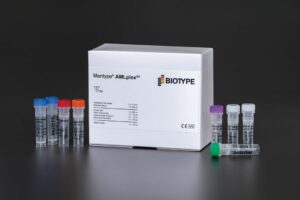 Rapid decisions: AML diagnosis in just 3 hours.
Guideline-compliant detection: Identification of 11 fusion genes in a single procedure.
Reliable results: Thanks to a comprehensive control concept.
CE-IVD registered product.
Mentype® AMLplexQS is the comprehensive multiplex approach for rapid detection of genetic abnormalities associated with acute myeloid leukemia (AML). The test helps reduce handling time by detecting all 11 fusion genes and a total of 34 transcript variants in a single multiplex PCR reaction. RNA isolated from blood or bone marrow is transcribed into cDNA and subsequently amplified using the optimized kit components for multiplex analysis.
The evaluation of chromosomal abnormalities has high prognostic value in almost all types of acute leukemia. Molecular biological evidence of chromosomal aberrations (translocations) represents an important diagnostic complement. The detection of specific translocations allows classification of leukemic disease subtypes and provides essential information for targeted patient therapy. According to ELN 2022 guidelines and WHO 2016 guidelines, risk categorization based on genetic abnormalities in AML is strongly recommended.
Mentype® AMLplexQS simplifies the detection of the most common chromosomal abnormalities observed to date in AML and represents an easy-to-use, routine-suitable, and reliable screening tool.
|
Fusion genes |
Chromosomal Aberrations |
Transcriptional variants |
|
RUNX1::RUNX1T1 |
t(8;21)(q22;q22) |
- |
|
BCR::ABL |
t(9;22)(q34;q11) |
e1a3, e14a2 (b3a2) e14a3. (b3a3), e13a2 (b2a2) e13a3 (b2a3) |
|
PICALM::MLLT10 |
t(10;11)(p13;q14) |
MLLT10_240-PICALM_1987 |
|
|
|
MLLT10_240-PICALM_2092 |
|
CBFB::MYH11 |
inv(16)(p13;q22) |
Type A, B, C, D, E, F, G, H, I, J |
|
DEK::NUP214 |
t(6;9)(p23;q34) |
- |
|
KTM2A::MLLT4 |
t(6;11)(q27;q23) |
- |
|
KTM2A::MLLT3 |
t(9;11)(p22;q23) |
6A_(THP1), 7A_(10A), |
|
|
|
8A_(MM6), 6B_(9B) |
|
KTM2A::ELL |
t(11;19)(q23;p13.1) |
e10e2,e10e3 |
|
KTM2A-PTD |
partial tandem duplication |
e9e3, e10e3, e11e3 |
|
NPM1::MLF1 |
t(3;5)(q25.1;q34) |
- |
|
PML::RARA |
t(15;17)(q22;q21) |
bcr1, bcr2 |
|
|
|
bcr3 |
|
Description |
Order code |
|
25 reactions |
45-31220-0025 |
|
100 reactions |
45-31220-0100 |
|
400 reactions |
45-31220-0400 |